
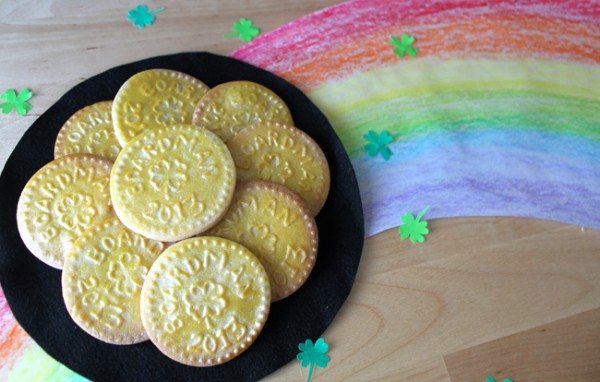
Personalized Gold Coin Cookie Stamps for St. Patrick’s Day
St. Patrick’s Day is nearly here, and you know your little leprechauns will be wanting to hoard some gold, so why not help them mint their own golden coin cookies with homemade custom cookie stamps!
[We have updated this to reflect a change. Upon further examination, I am not comfortable with us recommending polymer clay be used as a stamp for food. The directions are still below but they are to be used for non-food crafts. Use our salt dough stamp instead for cookies. ~ Isabel (3/14/13)]
Salt Dough Custom Cookie Stamp
I wanted to see if there was an easy way that the kids could make as many stamps as they wanted, so we experimented with making some stamps out of salt dough.
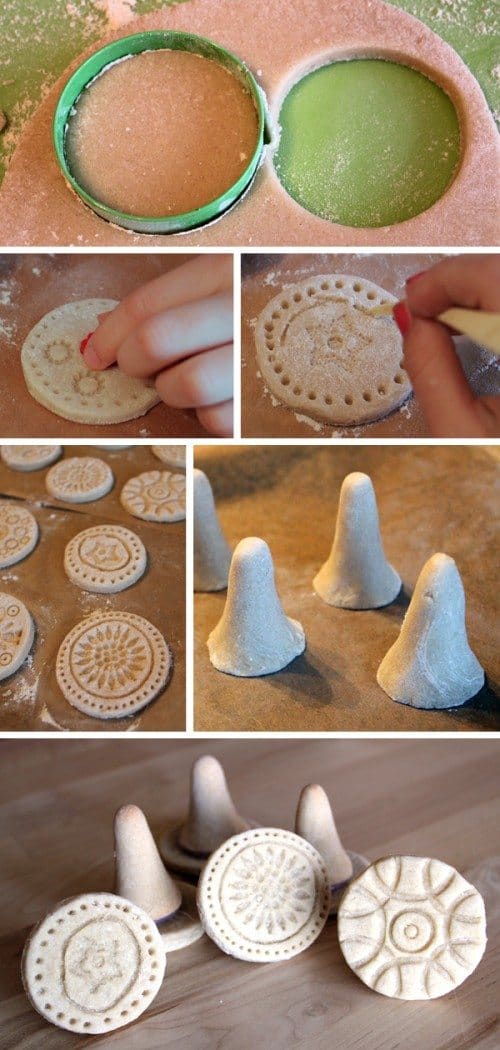
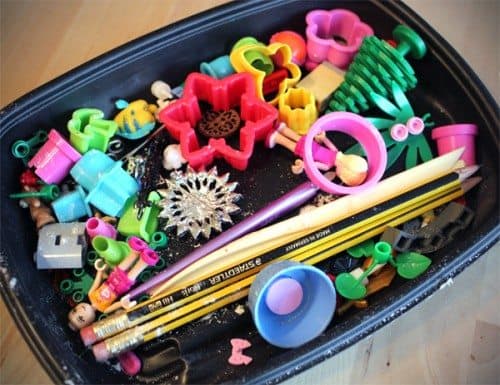
Salt dough “clay” is made from just one part hot water, one part salt and two parts plain all-purpose flour mixed together and kneaded into a smooth dough. The kids used a collection of small toys and interesting shaped objects from around the house to make their salt dough stamps.
I made them some handles from the salt dough that we could glue on once they were baked solid. The trick with salt dough is to bake it long and slow so that it doesn’t have any problems with air pockets distorting it. We left ours to air dry overnight and then I popped them in the oven on a low heat to finish them the next day.
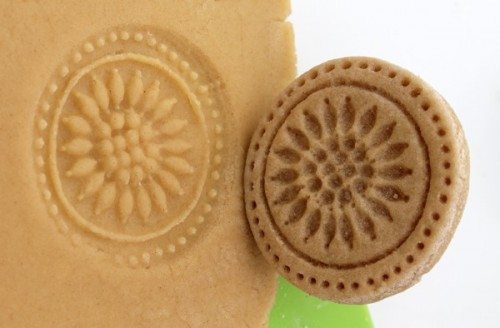
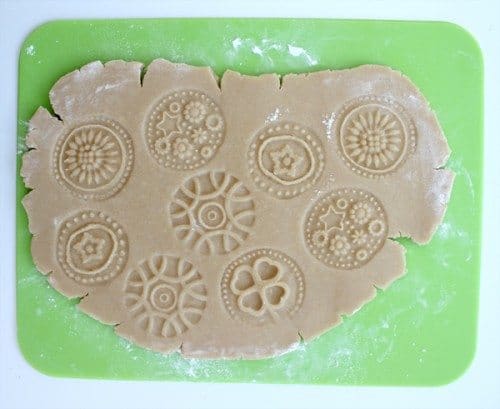
Happily we found that the salt dough stamps worked nearly as well as the polymer clay one had! Although they are unlikely to last as long or be as easy to clean.
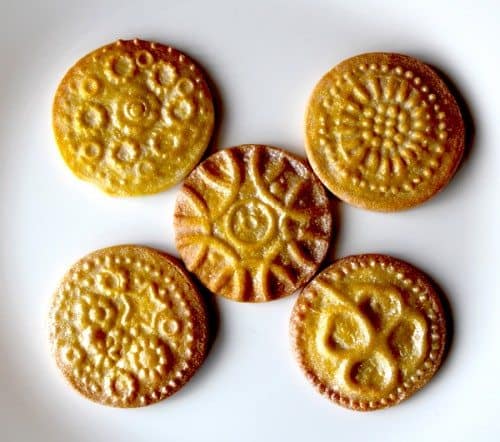
The cookie dough that we used for stamping was a basic sugar cookie recipe that we found on Sweetsugarbelle, but without the leavening ingredients (in this case, no baking powder was added). By not adding any raising agents to your dough you will be making your cookies less fluffy and crisper, but they will hold the stamped shapes a lot better. Shortbread dough also holds stamped patterns well.
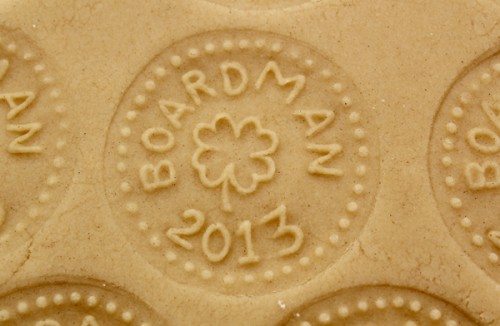
(this imprint was made with the polymer clay stamp, that we don’t recommend on food)
The dough was rolled out to the thickness that we wanted the finished cookie to be, because very little rising would happen in the baking process, and the stamp was used to imprint the dough. Sometimes the kids made an uneven stamp, but they just cut out the ones they were happy with and re-rolled the rest of the dough to stamp again.
Something that we found did help a lot with getting the detail of the stamp to hold up through baking was putting the stamped and cut out cookies in the freezer for 20 minutes before putting them into the hot oven to bake.
Rather than adding yellow food coloring to the dough, when the cookies came out of the oven we brushed them with some beaten egg white that had been colored with yellow food coloring while they were still hot. To add even more of a golden sparkle, we gave the finished cookies a light spray with some metallic food coloring spray.

Of course, you don’t have to just use this technique to make golden coin or leprechaun cookies for St. Patrick’s Day, you could make/ imprint your own custom and personalized cookie stamps for any occasion or holiday. For example, personalized birth announcements done this way would be adorable!
I hope you feel inspired to have a go and create your own Personalized Family Cookie Stamps unique to you and your loved ones.
***********
Custom (non-food) Polymer Clay Stamp
Polymer clay, such as Sculpey or Fimo, is the ideal material to craft your own customized stamps from, because it’s easy to work with and bakes hard and is easy to wash clean with soapy water to re-use. It can be found in a wide range of colors at most craft or hobby stores, for around $2 per packet. One packet is enough to make one complete custom stamp.
Our custom polymer clay stamp was made by rolling out half a packet of polymer clay to about a quarter inch thickness, and cutting a disk from it with a circular cookie cutter. The personalized imprint of our family name and date and the little four leaf clover were all made with a pencil, and then a circle of little dimples around the edge were added with the pencil point to make it look more like a coin. Remember that any writing you put on your stamp must be in mirror image!
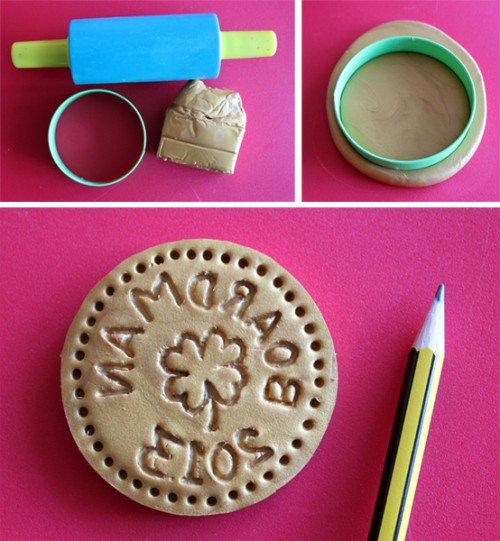
The other half of the packet of polymer clay was used to make two shapes that could be glued onto the disk to use as a handle when stamping.
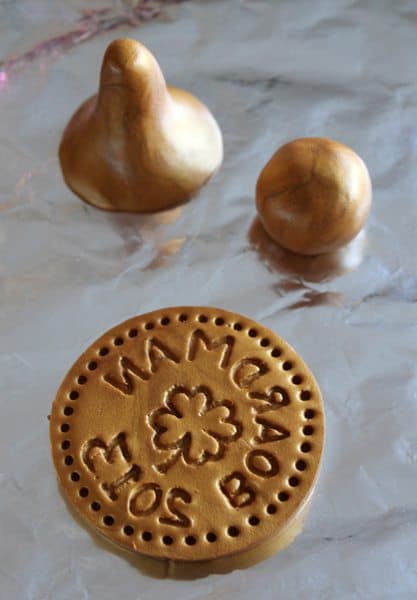
These were baked according to the instructions on the packet, and once cooled the three pieces were glued together with superglue. It’s important for safety reasons to bake clay according to package instructions. (Also, it’s good practice to always ventilate your area well when crafting.)
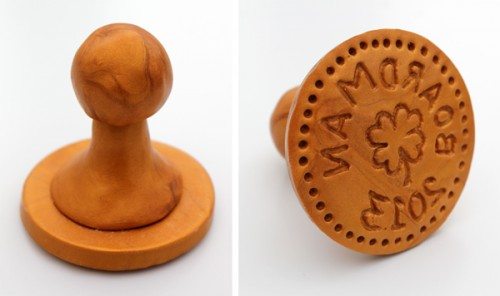
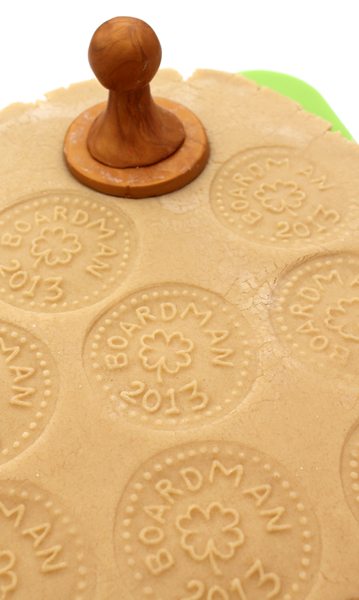
(this imprint was made with the polymer clay stamp, that we don’t recommend on food)